 Deutschland
 España
 France
 Italia
 United Kingdom















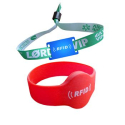
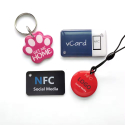
The essentials of wristband features for access management at sports competitions
The needs at a stadium differ from those of a conference or an outdoor gathering, and understanding how wristbands across event types are configured helps you match the right features to your own audience.
- Identification technology : RFID and NFC chips embedded in wristbands enable contactless scanning at entry points, allowing rapid access verification compared to manual checks at sports competitions.
- Anti-fraud security : Tamper-evident closures and unique serial numbers prevent duplication and transfer, ensuring each wristband grants access only to its authorized holder.
- Multi-zone access control : Color-coded or RFID-encoded wristbands segment entry permissions across general spectator areas, VIP sections, and staff-only zones from a single credential system.
- RFID vs barcode/QR : RFID allows contactless, high-speed scanning for large crowds, while barcode or QR wristbands require line-of-sight scanning and slower individual reads.
- Material types and durability : Tyvek wristbands suit single-day events, vinyl offers water resistance for short multi-day use, and woven fabric wristbands provide comfort and durability across extended multi-day competitions.
- Differentiated access tiers : Distinct wristband designs separate staff, VIP, and spectator categories, supporting crowd control and preventing unauthorized movement between restricted areas.
- Real-time data for organizers : RFID-enabled wristbands generate live entry and movement data, helping organizers monitor attendance flow, manage capacity, and respond to crowd density in real time.
What Wristbands Do in Sports Access Management
Wristbands act as wearable credentials that authorize entry, segment zones and keep crowds moving at sporting venues. They link each attendee to a verified ticket, so security teams can validate access in seconds and stop unauthorized entry before it reaches the gate. Sports competitions are just one setting where these credentials prove their worth, and the way wristbands across event types are configured shifts with each context and audience.
The shift from disposable paper stubs to smart credentials changed how organizers handle large competitions. A wristband stays on the wrist for the entire event, which removes the need to repeatedly check tickets and reduces queue friction. Events using RFID wristbands have reported up to 40% faster entry times. For a venue handling thousands of spectators, that difference decides whether gates flow smoothly or back up dangerously.
From paper tickets to smart credentials
Paper tickets tear, fade and get copied. A modern wristband carries a unique identifier that ties access rights, payment and zone permissions to one band. This consolidation matters when you manage staff, athletes and the public across a single competition.
Access control versus crowd control
These two roles overlap but serve different goals. Access control decides who may pass a given point; crowd control shapes how people circulate once inside. The right wristband features support both at once.
- Identification: confirm each holder against their ticket type and rights.
- Zone segmentation: separate spectators, VIP guests, press and operational staff.
- Speed at the gate: faster scanning shortens queues and eases pressure on security.
- Fraud prevention: deter pass sharing and counterfeit entry.
- Data capture: track flow and occupancy to manage capacity in real time.
Choosing the correct combination of features directly shapes safety and the spectator experience.
Identification Technology: RFID, NFC and QR Compared
Wristband identification relies on two main approaches: embedded chips (RFID and NFC) that store credentials wirelessly, and printed barcode or QR codes scanned optically. Events using RFID have reported up to 40% faster entry times, which makes the chip route the default for high-volume sports competitions.
How RFID and NFC wristbands work
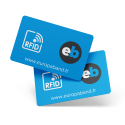
RFID : a radio-frequency chip embedded in the wristband transmits its data to a reader at the access point without contact. NFC is a short-range subset of RFID built for tap-based interactions, the same technology your attendees use for contactless payment.
At the gate, a reader captures the wristband data in a fraction of a second, validates the credentials against your access list, and opens the turnstile. Because nothing needs to be aimed or aligned, throughput stays high even during peak arrivals.
RFID versus barcode and QR wristbands
Barcode and QR wristbands are cheaper to produce but require visual line-of-sight scanning, which slows entry when crowds surge. RFID supports multi-use scenarios like cashless purchases and multi-zone access that printed codes simply cannot handle.
| Criterion | RFID / NFC | Barcode / QR |
|---|---|---|
| Entry speed | Up to 40% faster entry times | - |
| Cashless spending impact | 15-30% higher on-site spending | - |
| Cost per unit | $0.30 to $1.50 each | Sur devis |
| Multi-use (access + payment) | Yes | Limited |
| Line-of-sight required | No | Yes |
Choosing the right chip (LF, HF/NFC, UHF)
Three chip families serve different needs. LF (low frequency) suits short-range, robust reads. HF/NFC handles tap interactions and is ideal when you combine access with cashless payment at concession stands. UHF (ultra-high frequency) reads at longer distances, useful for fast spectator flows through wide gates.
Match the chip to your priorities: tap-based payments point toward NFC, while distance-driven throughput favours UHF. The right technology depends on your zones, your budget and your expected attendee volume.
Security Features That Prevent Fraud and Pass Sharing
The security features that prevent fraud at sports competitions rely on four pillars: tamper-evident closures, encrypted IDs, security inks, and rapid visual checks. Together, they ensure each credential stays with its rightful holder and cannot be duplicated, transferred, or reused between attendees.
Tamper-evident closures
A wristband only protects an event if it cannot be removed and reattached. Adhesive or snap closures that destroy the band on removal stop pass sharing at the gate.
- One-time adhesive seals that tear when stretched or peeled.
- Slip-lock plastic clasps that lock permanently once tightened.
- Tear-off tab systems, such as the Wrist-Rider® Wristicket® vinyl wristbands featuring 3, 4, or 5 tear-off tabs, to track multiple entries from a single credential.
Encrypted IDs and unique encoding
Beyond the physical band, the data layer matters. RFID and NFC chips carry encrypted unique IDs that bind each wristband to a single registered attendee in your access database. Cloned or guessed codes simply fail validation.
Unique sequential numbering: each printed serial corresponds to one record, so security staff and your system can flag any number that scans twice or appears outside its authorized zone.
Security inks and printing techniques
Printing choices defeat counterfeit attempts. Specialized inks and finishes make a forged wristband easy to spot under the right conditions.
- UV-reactive inks visible only under blacklight at checkpoints.
- Sequential barcodes or QR codes printed alongside the visual design.
- Custom holographic or foil elements that are costly to replicate.
Fast visual verification for security staff
Technology supports staff, but the human eye still works the fastest in dense crowds. Color-coded designs let security teams confirm access rights in under a second without scanning every wristband. Combine distinct colors, logos, and ink markers so checks stay quick at peak entry.
Watch for these counterfeit signals:
- Stretched or re-glued closures showing tampering.
- Faded or mismatched colors against the official sample.
- Missing UV mark under blacklight.
- Serial numbers that fail to validate on scan.
Durability, Comfort and Material Choices
The right material depends on how long attendees wear the band and what conditions they face. For a single-day sporting event, a lightweight option works fine, while multi-day competitions and outdoor festivals call for tear-resistant, water-proof construction that survives sweat, rain and constant movement without losing its hold.
Tyvek, vinyl and fabric wristbands
Each material answers a different need. Your choice shapes both the attendee experience and your control over fraud.
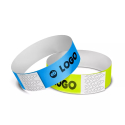
- Tyvek : a tear-resistant synthetic paper, economical and single-use. Ideal for one-day events with high spectator volumes.
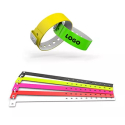
- Vinyl (plastic) : stronger and water-resistant, built for multi-day access. The Wrist-Rider® Wristicket® vinyl wristbands feature 3, 4, or 5 tear-off tabs for staggered entry or session validation.
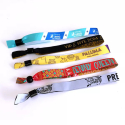
- Fabric : woven bands favoured at premium and multi-day events, comfortable enough for extended wear and difficult to remove cleanly.
Water and weather resistance
Outdoor sporting competitions expose wristbands to rain, sweat and accidental splashes. Vinyl and fabric wristbands resist water and hold their closure through several days of continuous wear. A band that fades, peels or loosens after the first shower becomes a security gap, since staff can no longer verify it at a glance. For aquatic events or anything spanning a full weekend, prioritise sealed plastic or woven fabric over paper-based options.
Comfort for long wear
Comfort matters when attendees keep the band on for hours or across several days. Smooth edges, breathable fabric and a secure but non-pinching closure prevent the irritation that pushes people to cut their wristband off, which then breaks your access chain.
For multi-day passes, woven fabric stays comfortable longest. For shorter sporting events where cost drives the decision, a soft Tyvek band keeps attendees comfortable through the day without the higher price of premium materials. Match the material to your event duration and the comfort expectations of your audience.
Custom Branding and Sponsor Visibility
Personalisation turns an access wristband into a communication tool. Beyond controlling entry, a custom-printed band carries your event identity, makes sponsors visible on every spectator's wrist, and helps security read access rights at a glance. A well-designed wristband works as a wearable sign that promotes your event and its partners throughout the competition.
Print and color options
Printing techniques and color choices shape both the look and the function of each band. Color coding already speeds up checks, so visual design and access logic work together rather than against each other.
- Full-color custom printing of your event logo, name, and dates.
- Distinct color schemes per access tier, so each zone reads instantly.
- Edge-to-edge artwork on vinyl, fabric, or Tyvek bands.
- Serial numbers and barcodes printed alongside the visual design.
- Matte or gloss finishes that hold up across multi-day formats.
Sponsor and event branding
A wristband sits on the wrist for the full duration of a sports competition, which makes it prime space for sponsor logos. Unlike a paper ticket that disappears into a pocket, the band stays in view during the entire experience, in stands, queues, and crowd photos.
For responsables événementiels managing partnerships, this visibility carries real value. The same surface that labels an attendee's access level also displays naming sponsors, much as it does at large festivals. You can dedicate one face to your event branding and reserve a panel for commercial partners, giving each sponsor measurable exposure without adding any extra item to distribute on site.
Real-Time Data and Cashless Capabilities
RFID and NFC wristbands turn every tap into usable data. They track entry flows live, enable on-site payments, and feed organizers detailed reports after the competition. Events using RFID have reported up to 40% faster entry times. The same chip that controls access also measures attendance and spending throughout the event.
Live capacity and crowd flow tracking
Each scan at a gate updates the count in real time, so your team sees exactly how many attendees are inside a stand or zone at any moment. This live picture helps manage capacity limits, spot bottlenecks at busy entry points, and redirect crowds before queues build up. For multi-day formats, it shows which sessions draw the heaviest traffic.
Cashless payments at venues
Wristbands linked to a prepaid balance let spectators pay at food stands, merchandise points, and bars with a single tap. The result is shorter queues and a smoother experience on site. Organizers report 15-30% higher on-site spending after switching to RFID payment. Cashless setups also reduce handling errors and cut the cash that staff must secure during the day.
Post-event analytics
Once the competition ends, the collected data becomes a planning asset for the next edition. The chips behind these features stay affordable, with RFID wristbands typically ranging from $0.30 to $1.50 each.
- Peak entry times per gate, to plan staffing more precisely.
- Zone-by-zone attendance, showing which areas drew the most visitors.
- Spending patterns across vendors and sessions.
- Dwell times that reveal how long attendees stayed in each space.
- Re-entry behaviour for multi-day passes.
Together these reports give organizers a factual base for pricing, layout, and sponsor decisions.
Eco-Friendly and Reusable Wristband Options
Sustainable wristbands let you control access while meeting CSR expectations. Reusable RFID bands and recycled-material wristbands cut single-use plastic waste across multi-day sports competitions without sacrificing security. For organizers under pressure to report on environmental impact, these materials answer a real procurement requirement.
Several eco-conscious formats now sit alongside standard access wristbands:
- Recycled PET fabric bands: woven from post-consumer plastic, comfortable for spectators across a full weekend.
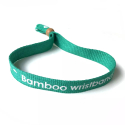
- Bamboo and natural-fiber straps: a renewable alternative to vinyl for premium or VIP tiers.
- Reusable RFID wristbands: collected at exit, reprogrammed, and redeployed for the next match or season.
- Compostable or biodegradable closures: reduce the landfill footprint of disposable entry passes.
Reusable RFID models carry an extra advantage: one band can serve several events, spreading the cost and the manufacturing impact across a longer lifecycle. That makes them practical for clubs running recurring fixtures rather than a single competition. Pairing durable materials with a clear collection point at the exit keeps the spectator experience smooth while supporting your sustainability goals, and lets you show partners a credible commitment beyond marketing claims.
How to Choose and Deploy Wristbands for Your Sports Event
Choosing the right wristbands comes down to matching four variables: material, identification technology, security level, and access zones, then testing them before gates open. Build your selection around your event duration and the volume of attendees, and validate every step on site before the first spectator arrives.
Selection checklist
Run through this list before placing an order. Each point ties back to a decision the previous sections already covered, so you can move from feature to purchase without gaps.
- Material: woven fabric for multi-day passes, soft Tyvek for single-day cost control.
- Technology: RFID where you need speed and data, QR or barcode for lighter budgets. Events using RFID have reported up to 40% faster entry times.
- Security: one-time closures, serial numbers, and tamper-evident features to block pass sharing.
- Zones: distinct colour schemes per access tier for staff, VIP, and spectators.
- Volume: order quantities that cover your expected attendance plus a margin for replacements.
- Custom branding: event logo and sponsor panels printed on the band surface.
- Budget: RFID wristbands typically range from $0.30 to $1.50 each.
Deployment and on-site testing
A wristband programme fails at the gate, not on the spec sheet. Test the full chain before you rely on it for thousands of people.
- Order samples of your chosen band and confirm print quality and closure strength.
- Programme a test batch of RFID or QR codes and scan them through your readers.
- Brief your security and access staff on colour codes and check procedures.
- Run a live entry simulation at one gate to measure scan speed and queue flow.
- Confirm reader coverage across every zone, including VIP and back-of-house.
- Keep a stock of spare wristbands for damaged or replacement cases.
Organizers who validate readers, staff briefing, and stock levels in advance avoid the bottlenecks that turn a smooth competition into a queue management crisis.
Frequently Asked Questions
Are RFID wristbands worth it for small sports events?
Yes, even at modest scale. Events using RFID wristbands have reported up to 40% faster entry times, which reduces gate queues regardless of crowd size. With unit prices ranging from $0.30 to $1.50 each, the investment stays accessible while improving access control and the spectator experience.
Can wristbands be reused across multiple competition days?
Reusable RFID wristbands are designed exactly for this. They are collected at the exit, reprogrammed, and redeployed for the next match or season. For clubs running recurring fixtures, this spreads the cost across several events and keeps your multi-day access management consistent.
How do wristbands prevent counterfeit access?
Each RFID chip carries a unique encrypted identifier that cannot be photographed or cloned like a printed pass. Tamper-evident closures break if removed, blocking pass sharing. For tiered vinyl options, the Wrist-Rider Wristicket vinyl wristbands feature 3, 4, or 5 tear-off tabs to validate separate entries securely.
Which material is best for outdoor sports competitions?
Recycled PET fabric bands handle weather and sweat well across a full weekend, staying comfortable for spectators. Vinyl resists tearing and water for shorter fixtures, while reusable RFID bands suit recurring outdoor events. Your choice depends on duration, weather exposure, and whether you plan to collect and reprogram them.
How far in advance should wristbands be ordered?
Plan ahead based on your customization needs. Custom-printed designs with sponsor branding, encoding, and multi-zone color coding require lead time for proofing and production. Ordering early also lets you test the RFID system and staff scanning workflow before gates open, avoiding last-minute issues on competition day.